


A home value estimator is an online tool that calculates your property’s approximate market value using publicly available data and algorithms. These tools, formally called Automated Valuation Models (AVMs), pull from tax records, recent sales, and property details to generate a fast estimate. For homeowners in Kissimmee, Meadow Woods, Hunters Creek, and Southchase, they offer a useful starting point before making any buying or selling decision. The key is knowing what these tools can and cannot tell you, and when to bring in local expertise to fill the gaps.
How do home value estimators work?
A home value estimator runs on an Automated Valuation Model, or AVM. This is a mathematical program that analyzes publicly available data to calculate an estimated market value for a specific property.
The core data inputs include:
- Public tax records: Assessed value, ownership history, and property classification
- Property details: Square footage, bedroom and bathroom count, lot size, and year built
- Recent comparable sales: What similar homes in your zip code sold for in the past 90–180 days
- Location data: Proximity to schools, parks, transit, and commercial areas
- Market trend data: Broad appreciation rates tracked by indexes like the FHFA House Price Index, which monitors average price changes across local markets
The AVM feeds all of this into a statistical model and produces a single number. That number is your estimate.
The problem is that online estimators often miss unique home conditions or renovations because they rely on standardized data like size and room count. A kitchen remodel, a new roof, or a screened-in lanai does not automatically appear in public records. The AVM has no way to see what makes your home different from the one two streets over.

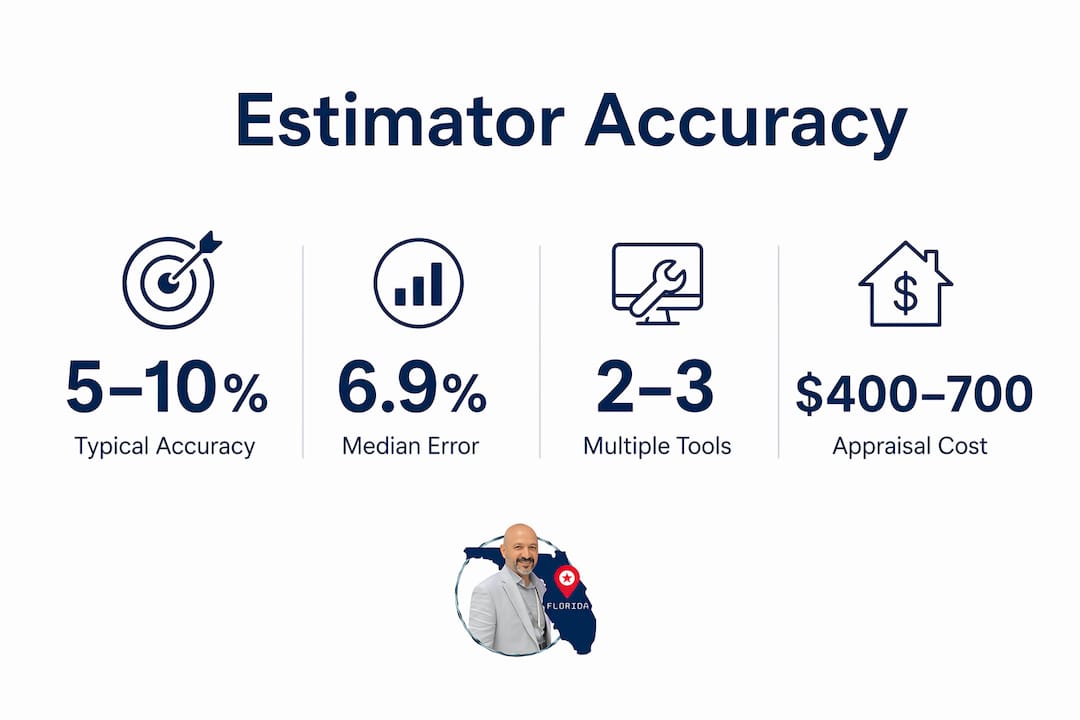
Pro Tip: Run your address through two or three different online property estimators and note the range. If the estimates vary by more than 10%, that gap signals your home has features or conditions that automated tools cannot capture well.
How accurate are home value estimators?
AVMs are typically accurate within 5–10% of the actual sale price for standard properties. Some models report a median error of 6.9% for off-market homes and as low as 2% for homes actively listed on the MLS.
That accuracy gap matters more than it sounds. On a $350,000 home, a 7% error equals $24,500 in either direction. Pricing your home $24,000 too high in Kissimmee’s competitive market can cost you weeks of sitting unsold.
Several factors reduce AVM reliability:
- Sparse sales data: AVMs perform best in active markets. If your neighborhood has few recent sales, the model has less data to work from.
- Unique property features: Custom builds, unusual lot configurations, and major renovations are invisible to most algorithms.
- Rapidly shifting markets: AVMs lag behind fast-moving conditions because they depend on closed sales, which reflect prices from 30–90 days ago.
- Property condition: A home with deferred maintenance and a home in pristine condition can share the same AVM estimate if their recorded specs match.
Homeowners often overestimate the accuracy of online estimates by failing to account for upgrades and neighborhood trends that directly affect actual sale prices. Treat any single estimate as a range, not a fixed number.
What factors most influence your home’s value in South Orlando?
Location is the single most powerful driver of home value. Two identical homes can differ in value by hundreds of thousands depending on zip code and neighborhood. Within a city, location alone can cause 30% or more variation in price.
Here are the factors that carry the most weight in South Orlando markets like Meadow Woods, BVL, and Hunters Creek:
- School district quality. Homes zoned for higher-rated schools consistently attract more buyers and command higher prices. Location and neighborhood desirability, including school districts, can influence value by 10–20%.
- Square footage and usable living space. Buyers pay per square foot. Finished square footage counts; unfinished garages and attics do not.
- Condition of major systems. Roof age, HVAC performance, and plumbing condition affect both appraisal value and buyer confidence. A new roof adds $12,000–$15,000 in value on average.
- Kitchen and bathroom upgrades. These rooms drive the highest return. Physical upgrades in kitchens and bathrooms recoup 60–80% of renovation cost in added value.
- Lot size, views, and amenities. Corner lots, water views, and community pools all add measurable value that AVMs frequently undercount.
Pro Tip: Before listing, walk your home as a buyer would. Note every upgrade you have made in the past five years and prepare a written list for your agent. This list directly informs your Comparative Market Analysis.
How can homeowners improve estimate accuracy and validate home value?
No single tool gives you the full picture. The most reliable home worth assessment combines automated data, broad market trends, and local expert analysis.
Follow these steps to get a number you can actually use:
- Run multiple online estimators. Use two or three free online property estimators to establish a baseline range. Note where they agree and where they diverge.
- Check the FHFA House Price Index. The FHFA HPI calculator tracks average appreciation for local markets. It does not account for individual property conditions, but it gives you a reliable read on whether your area is trending up or down.
- Review comparable sales yourself. Osceola County property records are publicly available. Search recent closed sales within a half-mile of your home for homes with similar square footage and bedroom count.
- Request a Comparative Market Analysis from a local agent. A CMA from an agent who knows Kissimmee gives you hyper-local adjustments that no algorithm can replicate. Local agents analyze current buyer demand, competing inventory, and neighborhood specifics that automated models cannot fully capture.
- Hire a licensed appraiser when precision is required. Professional appraisals cost $400–$700 and provide the legally recognized valuation required for selling, refinancing, or legal matters. If you are within six months of listing, a pre-listing appraisal is worth the investment.
A multi-step valuation approach using online AVMs for baseline, the FHFA HPI for trend context, and a local agent CMA for hyper-local adjustments produces the most reliable result. Each layer adds information the previous one cannot provide.
Pro Tip: If your appraisal comes back lower than expected, you can formally contest it. Lenders allow reconsideration requests if you can provide comparable sales the appraiser did not include. This is worth doing, especially in fast-moving South Orlando neighborhoods.
What should sellers and buyers know before relying on estimates?
A house price estimator gives you a ballpark, not a contract price. Using it well means understanding its role in the bigger picture.
For sellers, the most common mistake is anchoring to the first number they see. If an online real estate valuation tool shows $385,000, that figure may not reflect your updated flooring, fresh exterior paint, or the new community pool your HOA just opened. Sellers who list based solely on an automated figure often price too high or too low and pay for it in time or money.
For buyers in Kissimmee, these tools help you spot overpriced listings quickly. If a home is listed at $420,000 and multiple estimators put it at $375,000–$390,000, that gap is worth investigating before you make an offer.
A few practical rules for both sides:
- Never rely on a single estimate. Cross-reference at least two sources before forming a price opinion.
- Factor in seasonality. South Orlando’s market moves faster in winter months when northern buyers are active. Estimates based on summer sales may understate current demand.
- Use valuations to negotiate, not to anchor. A well-documented valuation range gives you leverage in offer negotiations without locking you into one number.
- Consult an agent before you act. Understanding serious buyer signals and market timing requires human judgment, not just data.
The home appraisal remains the gold standard for pricing a home to sell and is required by lenders. Automated estimates are a starting point, not a finish line.
Key Takeaways
The most reliable home value assessment combines automated AVM tools, the FHFA House Price Index for trend context, and a local agent CMA for hyper-local accuracy that no algorithm can replicate alone.
| Point | Details |
|---|---|
| AVM accuracy range | AVMs are typically accurate within 5–10% of actual sale price, with lower error for listed homes. |
| Location drives value | Neighborhood and school district can shift home value by 10–20% or more within the same city. |
| Renovations matter | Kitchen and bathroom upgrades recoup 60–80% of cost; a new roof adds $12,000–$15,000 in value. |
| Professional appraisal cost | Licensed appraisals run $400–$700 and are required for selling, refinancing, or legal purposes. |
| Best validation method | Combine multiple online estimators, county records, FHFA HPI data, and a local agent CMA. |
What I have learned from watching estimates miss the mark
I have been working in Meadow Woods, Hunters Creek, and BVL long enough to see the same pattern repeat. A homeowner checks an online estimator, gets a number they like, and builds their entire pricing strategy around it. Then the CMA comes back $20,000 lower, and suddenly we are having a harder conversation than we needed to.
The truth is, automated tools are genuinely useful. I am not dismissing them. But they are built on closed sales data, and South Orlando moves fast. By the time a sale closes, gets recorded, and feeds into a model, the market may have already shifted. I have seen homes in Southchase sell above their AVM estimate by a meaningful margin simply because two motivated buyers competed for the same property in the same week.
What I tell every homeowner I work with is this: use the estimator to get oriented, then call me. The number I give you will account for what your neighbor’s kitchen looked like versus yours, what the school rezoning last year did to buyer demand in your subdivision, and whether the new development on Osceola Parkway is pulling buyers toward or away from your street. That context is what turns a rough estimate into a real pricing strategy.
The biggest mistake I see is homeowners ignoring property condition entirely. Two homes with identical square footage and the same AVM estimate can sell $30,000 apart because one has a five-year-old roof and updated bathrooms and the other does not. Algorithms cannot see that. I can. For more guidance on avoiding common valuation mistakes, the seller resources at Meetramy are a good place to start.
— Ramy
Ready to go beyond the estimate?
Online tools give you a starting point, but selling your home in Kissimmee, Meadow Woods, or Hunters Creek takes more than a number from an algorithm. Ramy G Girgis at Meetramy provides a full Comparative Market Analysis grounded in real, current local sales data, not just averages.

Whether you are preparing to list, thinking about refinancing, or just want to know where you stand, a conversation with a local expert costs you nothing. Meetramy covers Meadow Woods, Hunters Creek, Southchase, BVL, and the surrounding South Orlando area. Explore local seller resources and get the kind of pricing guidance that actually holds up when you sit across the table from a buyer.
FAQ
What is a home value estimator?
A home value estimator is an online tool that uses an Automated Valuation Model to calculate your property’s approximate market value based on public records, recent sales, and property details.
How accurate are online home value estimators?
AVMs are typically accurate within 5–10% of actual sale price, with some models reporting a median error of 6.9% for off-market homes and around 2% for actively listed homes.
What is the most reliable way to assess home value?
The most reliable approach combines multiple online estimators for a baseline, the FHFA House Price Index for market trend context, and a Comparative Market Analysis from a local agent for hyper-local accuracy.
When do I need a professional home appraisal?
A licensed appraisal, which costs $400–$700, is required by lenders for selling or refinancing and provides the legally recognized valuation needed for formal transactions or legal matters.
Why does my home’s estimated value vary between tools?
Different tools use different data sources and model weights, and none can capture recent renovations, property condition, or fast-moving local market shifts, which is why estimates often diverge by thousands of dollars.
Recommended
- Back Links – Ramy G Girgis – Your Hardest Working Starter-Home Realtor® in Meadow Woods, FL
- knowledge – Ramy G Girgis – Your Hardest Working Starter-Home Realtor® in Meadow Woods, FL
- The #1 Mistake First-Time Home Buyers Make in Florida – Ramy G Girgis – Your Hardest Working Starter-Home Realtor® in Meadow Woods, FL
- 7 Signs You’re Dealing With a SERIOUS Buyer – Ramy G Girgis – Your Hardest Working Starter-Home Realtor® in Meadow Woods, FL