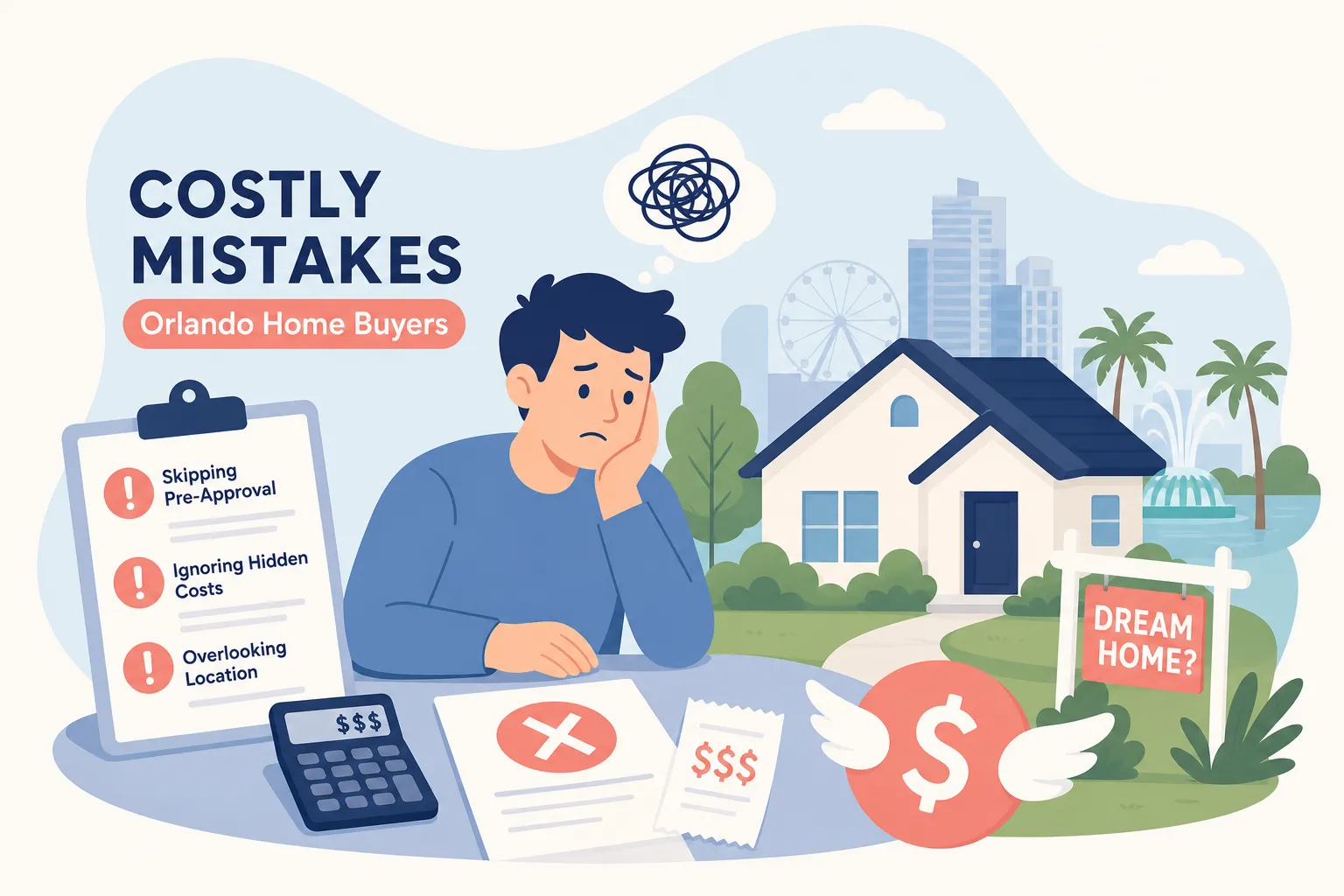

A buyer in South Orlando found a home she loved in Meadow Woods. The market was hot, inventory was thin, and two other offers were already on the table. Her agent suggested waiving the inspection to make the offer more competitive. She won the deal. Two months after closing, a roofer told her the shingles were failing and there was mold behind the master bath wall. The repair bill came to just under $28,000. She hadn’t budgeted a dollar of it.
Knowing which home buying errors to avoid in Orlando before you start your search is the difference between a smooth closing and a costly first year. The speed of a competitive offer situation, combined with Florida’s genuinely unusual homeownership costs and inspection requirements, creates a specific set of pitfalls that trip up buyers who aren’t prepared for this market. These aren’t failures of intelligence, they’re failures of preparation and local knowledge. Orlando’s market doesn’t punish uninformed buyers slowly. When problems surface, they tend to arrive all at once, usually within the first twelve months.
What follows is a grounded look at the Orlando home buying mistakes that cost Central Florida buyers the most, and what to do instead before you make your first offer.
Getting your financing in the wrong order
Most downstream problems in a home purchase trace back to financing missteps made in the first week of the search. Buyers who don’t establish a clear, verified financial picture before touring homes either lose deals to better-prepared buyers, overbid out of urgency, or miss programs that could have saved them thousands of dollars.
Confusing pre-qualification with actual buying power
Pre-qualification is a lender pulling a rough estimate from self-reported income and a soft credit check. Pre-approval is a verified, underwritten decision based on actual tax returns, pay stubs, and a hard credit pull. In Orlando’s active market, listing agents and sellers treat pre-qualification letters far less seriously than a full pre-approval. A buyer who makes an offer with only a pre-qualification letter starts the negotiation at a disadvantage before the conversation even begins. Get the real pre-approval first, before you tour a single home. To learn how prepared buyers stand out in competitive markets, read 7 Signs You’re Dealing With a SERIOUS Buyer.
Not knowing Florida’s down payment assistance landscape
A significant number of Orlando buyers assume they need 10 to 20 percent saved before homeownership is realistic. That assumption costs them years. Florida Housing Finance Corporation offers statewide programs, including FL Assist (up to $10,000 as a deferred second mortgage) and the PLUS Second Mortgage (3 to 5 percent of the loan amount, forgivable over five years), both of which must be paired with an eligible Florida Housing first mortgage. Orange County’s own Down Payment Assistance Program offers up to $70,000 for qualifying buyers. Osceola County has SHIP-funded assistance as well.
Some buyers miss these programs entirely when their agent doesn’t handle financing and their lender lacks experience with Florida’s local offerings. That’s why working with an advisor who understands multiple Florida DPA programs matters from the very first conversation. Ramy G Girgis, Florida Realtor® & Mortgage Advisor, approaches every client consultation this way, reviewing program eligibility before the home search begins, so buyers don’t leave real money on the table before they even make an offer.
Home buying errors to avoid in Orlando: inspections are not optional
Waiving or limiting inspections is one of the single most expensive decisions a buyer can make in the Florida market. The pressure of a multiple-offer situation can make it feel like the only move available. It rarely is. In competitive Orlando neighborhoods, buyers who skip the inspection to win the deal are routinely the ones absorbing five-figure repair bills within their first year of ownership.
What you risk by waiving the general home inspection
The most common red flags in Central Florida homes include aging roofs, particularly on 2003 to 2007 builds, HVAC ductwork degradation in unconditioned attics, and water intrusion around windows and stucco. A full roof replacement in Orlando typically runs $8,000 to $20,000. A complete HVAC replacement ranges from $6,000 to $12,000. Mold remediation tied to water intrusion can add another $2,000 to $15,000. A buyer who waives the inspection to win a deal can face $20,000 to $40,000 in repair costs before the first anniversary of closing, costs that weren’t in the budget and can’t be negotiated after the fact.
The Florida-specific inspections most buyers forget
Beyond the standard general inspection, Florida properties require a different checklist. A 4-point inspection, covering the roof, HVAC, electrical, and plumbing, is required by many Florida insurers for older homes and typically costs $150 to $175. A wind mitigation inspection runs $150 to $200 and can reduce annual insurance premiums by hundreds of dollars. Pools require their own specialist. And because Orlando sits over limestone and shifting sandy soils, a foundation specialist inspection is worth the cost in many South Orlando neighborhoods, where Florida soil types and their impact on foundations make a real difference. Out-of-area agents unfamiliar with Florida’s soil conditions and insurer requirements rarely suggest these additional inspections. This is part of the home inspection checklist Orlando buyers need, and local knowledge here is not a luxury.
Underestimating what Florida homeownership actually costs
The monthly payment calculation that buyers run in their head, or on a lender’s basic mortgage calculator, routinely leaves out four to five figures of annual cost. By the time reality arrives, the buyer is already in the house.
Insurance sticker shock and what drives it
Florida homeowners insurance averages around $2,315 per year for a $300,000 home based on industry estimates, but that number climbs fast in practice. Older roofs, flood zone proximity, and higher coverage limits can push premiums to $6,000 to $10,000 annually. Roof age is the single biggest driver: many insurers reject or heavily surcharge roofs older than 15 to 20 years. Flood insurance adds another $700 to $4,000 per year depending on FEMA zone designation. Buyers who calculate affordability based on principal, interest, taxes, and a generic insurance estimate are often house-poor by month three. Understanding Orlando closing costs and insurance together, before the offer goes in, is the only way to build an accurate budget.
Closing costs, HOA fees, and CDD surprises
Florida’s documentary stamp taxes and intangible taxes push closing costs higher than a standard “2 to 3 percent” estimate suggests. On a $400,000 purchase in Orange County, total closing costs average around $11,255, closer to 2.8 percent. Newer master-planned communities in South Orlando carry Community Development District fees of $200 to $300 per month on top of HOA dues, and these CDD fees appear on the property tax bill rather than the HOA statement, making them easy to miss during offer review. First-year property tax bills without a homestead exemption can run $500 to $1,200 higher than the prior owner’s bill. Every one of these line items needs a close look before the offer goes in, not after the contract is signed. For a county-by-county look at typical closing costs in Florida, see this guide to Florida closing costs by county.
Making emotional decisions in a low-inventory market
Fear of missing out is not a strategy. In South Orlando neighborhoods like Meadow Woods, Hunters Creek, and Southchase, well-priced inventory still draws multiple offers. Buyers who don’t set a clear ceiling before they tour homes end up making decisions driven by anxiety rather than comparable sales data.
Overbidding without a clear ceiling
Without a pre-established walk-away number, buyers routinely bid $15,000 to $30,000 over list price on homes that appraise at a lower value. When the appraisal comes in short and there’s no appraisal contingency in place, the buyer either covers the gap in cash or loses the deal along with their earnest money. Setting a ceiling based on what comparable homes have actually sold for, not what the listing makes you feel, is the simplest protection against that outcome. For a practical tool on local valuations, consult this Home Value Estimator resource.
Choosing the house over the lifestyle
Out-of-state and first-time home buyers in Orlando frequently fall in love with a home’s finishes while ignoring the daily reality of its location. Proximity to Florida’s Turnpike toll system, school zone assignments, flood zone designations, and neighborhood CDD structures all affect long-term satisfaction and carrying cost. A buyer who moves to a remote part of Osceola County for a lower price point may find that the commute, the insurance exposure, and the resale challenges outweigh the initial savings. An advisor who has worked the same zip codes for years brings context that no listing portal can replicate. For common pitfalls first-time buyers face nationwide, this list of first-time home buyer mistakes is a helpful supplement to local guidance.
Missing Florida-specific red flags that surface late in the deal
Some of the costliest issues in a Central Florida purchase don’t surface until after an offer is accepted, when reversing course is expensive or impossible. Knowing what to look for before making an offer is the only reliable defense.
Roof age and the insurability problem
In Florida, roof age directly affects whether a buyer can obtain homeowners insurance, and therefore whether a lender will fund the loan. Many buyers don’t discover the roof age issue until the 4-point inspection comes back after contract. Roofs older than 20 years (some insurers draw the line at 15) trigger either coverage denial or premiums that exceed the buyer’s budget. Knowing how to evaluate roof age and condition before making an offer, and building appropriate repair credits or seller concessions into the negotiation, is a skill that separates locally experienced agents from generalists. Hurricane and flood risk when buying in Orlando compounds this, an aging roof in a high-wind zone creates both an insurance problem and a safety liability.
Flood zones and hidden water risk
FEMA flood map designations in Orange and Osceola counties are more nuanced than buyers realize. A home outside a mandatory flood zone can still carry real water intrusion risk due to drainage patterns, proximity to retention ponds, or grading issues on a specific lot. Buyers who skip a flood zone check and a drainage assessment during due diligence can inherit problems that no insurance policy fully covers. A local agent familiar with specific streets and subdivision drainage histories provides a layer of protection that a general market search simply cannot.
Why local, dual-licensed guidance catches these mistakes early
Most buyers work with a real estate agent and a lender who communicate imperfectly and review different parts of the deal at different times. The agent sees the listing. The lender sees the loan application. Nobody is looking at both simultaneously until something goes wrong.
One advisor who sees the full picture before you commit
A dual-licensed agent and mortgage advisor reviews the financing implications of every property before an offer goes in: roof age against insurability, HOA and CDD fees against debt-to-income limits, down payment assistance eligibility against offer structure. Ramy G Girgis, Florida Realtor® & Mortgage Advisor, works this way across Meadow Woods, Southchase, and Hunters Creek. Buyers get a single point of contact who understands the financing implications of each home before the offer goes in, not just someone who sees the listing price and hands off the loan to a separate team.
Local market knowledge that generalist agents don’t have
That means knowing which Meadow Woods subdivisions carry CDD fees, which streets have drainage histories, and which 2005-built Southchase homes are approaching roof replacement. That kind of neighborhood-specific knowledge only comes from working the same zip codes for years. Combined with in-house mortgage pre-approval and familiarity with Florida’s down payment assistance programs, a local dual-licensed model removes most of the guesswork that leads to the Central Florida home buying pitfalls covered in this article. These are the buyer’s agent tips Orlando buyers rarely hear until it’s too late.
Slow down before you start
Think back to the buyer in the opening story, the one who moved fast, waived the inspection, and spent her first year paying for that decision. The outcome wasn’t inevitable. It was the predictable result of a process that prioritized speed over preparation. For a concise look at the single biggest misstep many first-time buyers make in Florida, see The #1 Mistake First-Time Home Buyers Make in Florida.
The buyers who close with confidence follow a different sequence. They secure a real pre-approval before they tour a single home. They understand their actual monthly cost before they fall in love with a floor plan. They complete every Florida-specific inspection the property requires. They set a firm ceiling before they walk into a showing. They partner with someone who knows the local market from both the real estate and the mortgage side.
None of these steps require luck. They require preparation and the right local guidance. Avoiding the home buying errors to avoid in Orlando that show up in this article starts well before your first offer, it starts with the advisor you choose at the beginning of the process. If you’re thinking about buying in the South Orlando area, reaching out to Ramy G Girgis, Florida Realtor® & Mortgage Advisor, before your search begins is a better investment than learning these lessons after closing. And when foundation or sinkhole concerns do arise, it’s worth knowing local remediation specialists, see this resource on top-rated sinkhole repair experts in Florida for remediation context.