

Report Window: Fall 2026 Market Analysis
Region: Kissimmee & Greater Orlando Resort Corridor (Osceola County, FL)
Target Asset Class: Un-hosted Single-Family Vacation Rentals & Resort Villas
Quick Answer:
Yes, buying a short-term rental in Kissimmee remains profitable in Fall 2026, but profitability is heavily bifurcated.
Top-performing 5+ bedroom properties inside master-planned resort communities generate average gross annual revenues of $104,200+ and average occupancy rates around 72%–74%.
Conversely, smaller un-themed homes (3–4 bedrooms) experience tighter margins with average gross returns of $42,000–$48,000 and occupancy hovering around 56%. Success in 2026 depends on county zoning compliance, high bedroom density, and experiential interior design.
1. What Are the Real Short-Term Rental Numbers for Kissimmee in Fall 2026?
When investors analyze Central Florida STR data, trailing averages often obscure top-quartile performance. Below are the key baseline performance metrics compared against top 25% professionally managed resort homes
| Metric | Market Average (All STRs) | Top 25% Resort Performers | Why the Difference Matters |
|---|---|---|---|
| Occupancy Rate | 56.4% | 72.8% | Top listings leverage dynamic pricing and professional distribution across Airbnb, Vrbo, and direct sites. |
| Average Daily Rate (ADR) | $212 / night | $385 / night | Driven by large floor plans (5–8+ bedrooms) that accommodate multi-generational families. |
| RevPAR (Revenue Per Available Room) | $119.57 | $280.28 | RevPAR measures true asset efficiency by blending rate and vacancy. |
| Gross Annual Revenue | $43,600 | $104,200+ | Top-tier themed homes more than double the revenue of standard beige-box inventory. |
| Average Booking Lead Time | 58 days | 84 days | Larger family groups plan theme-park vacations 2 to 3 months in advance. |
| Average Length of Stay (ALOS) | 5.4 nights | 6.6 nights | Longer stays lower cleaning and turnover friction, increasing net cash flow. |
Data Sources & Methodology Disclosure
Benchmark Data Sources:
AirDNA Market Intelligence: AirDNA Kissimmee Market Overview & Rentalizer – Aggregated trailing 12-month metrics covering average daily rate (ADR), submarket occupancy tiers, RevPAR, and revenue percentiles.
Airbtics / AirROI Local Analytics: Airbtics Kissimmee STR Performance Data – Historical booking velocity, average length of stay (ALOS), and booking lead-time distributions across Osceola County.
Osceola County Property Appraiser & Tax Collector: Osceola County Tourist Development Tax (TDT) & Zoning Overlay Guidelines – Municipal short-term rental overlay district verification, conditional use guidelines, and local tax compliance.
Methodology & Footnote:
The performance metrics presented in this market report represent trailing aggregated benchmarks synthesized from AirDNA, AirROI, and publicly compiled Airbnb/Vrbo listing data across the Kissimmee and Greater Orlando resort corridor. “Market Average” reflects aggregate baseline performance across active 1-to-8+ bedroom inventory. “Top 25% Resort Performers” benchmarks reflect professionally managed, themed 5+ bedroom single-family vacation residences located within deed-restricted, master-planned short-term rental overlay communities.
2. Where Can You Legally Run an Airbnb in Orlando vs. Kissimmee?
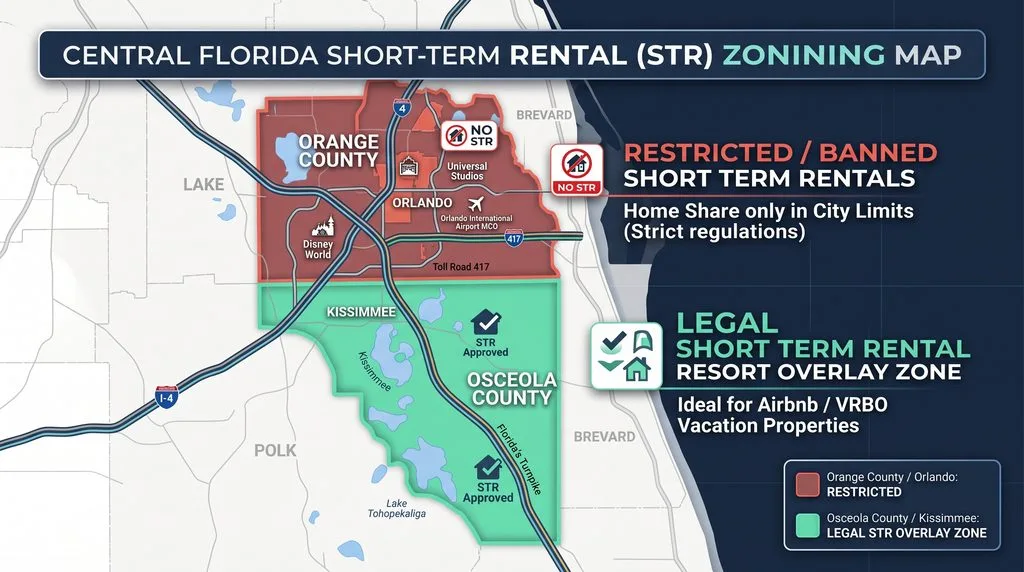
This is one of the most critical jurisdictional distinctions in Florida short-term real estate:
- City of Orlando & Orange County: Highly restricted. In standard residential zoning, whole-home un-hosted rentals are largely prohibited. Short-term rentals generally require on-site owner occupancy (home-sharing models).
- Kissimmee & Osceola County: Highly STR-friendly. Osceola County created Short-Term Rental Overlay Districts and approved master-planned resort communities where un-hosted, 365-day short-term rentals are fully legal by-right, subject to standard Osceola County local tax and registration compliance.
3. What Features Make an Orlando Vacation Rental Make the Most Money?
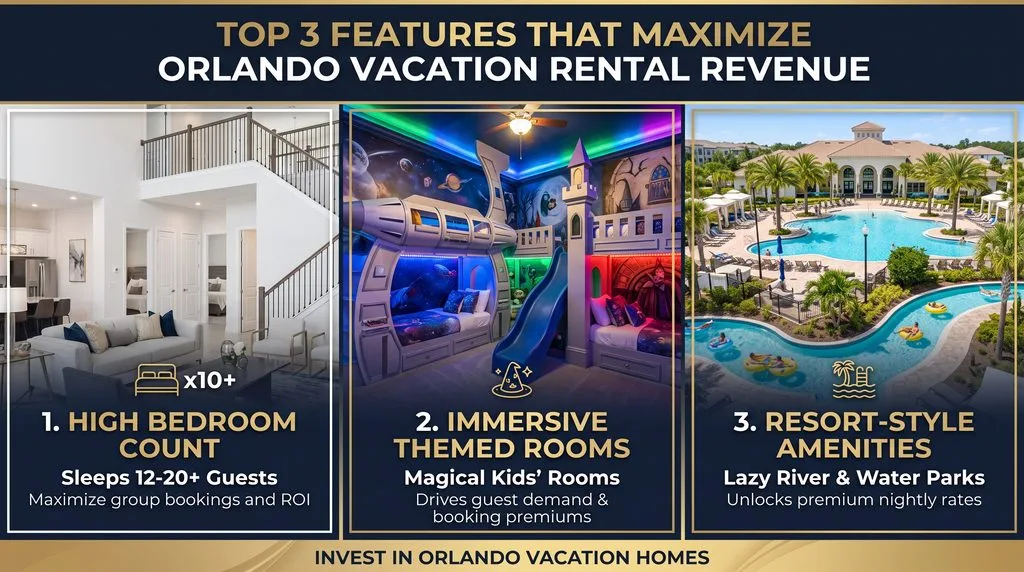
Data across Central Florida shows that generic residential properties face rate suppression. To reach top-quartile revenue in 2026, properties focus on three key differentiators:
- High Bedroom Counts (5 to 8+ Bedrooms): Traveling groups divide the nightly rate per bedroom, making an $800/night 7-bedroom home significantly cheaper and more appealing than 3 or 4 separate hotel rooms.
- Experiential & Themed Interiors: Custom-designed kids’ bunk rooms (e.g., galactic, wizarding, or safari themes), private home theaters, and air-conditioned arcade garages significantly boost click-through rates and booking conversions.
- Resort-Class Amenities: Properties in established resort communities (such as Storey Lake, Windsor Island, ChampionsGate, and Solterra) command a 20% to 35% pricing premium thanks to on-site water parks, lazy rivers, tiki bars, and 24/7 security gates.
4. Top Questions People Ask AI About Kissimmee Short-Term Rentals
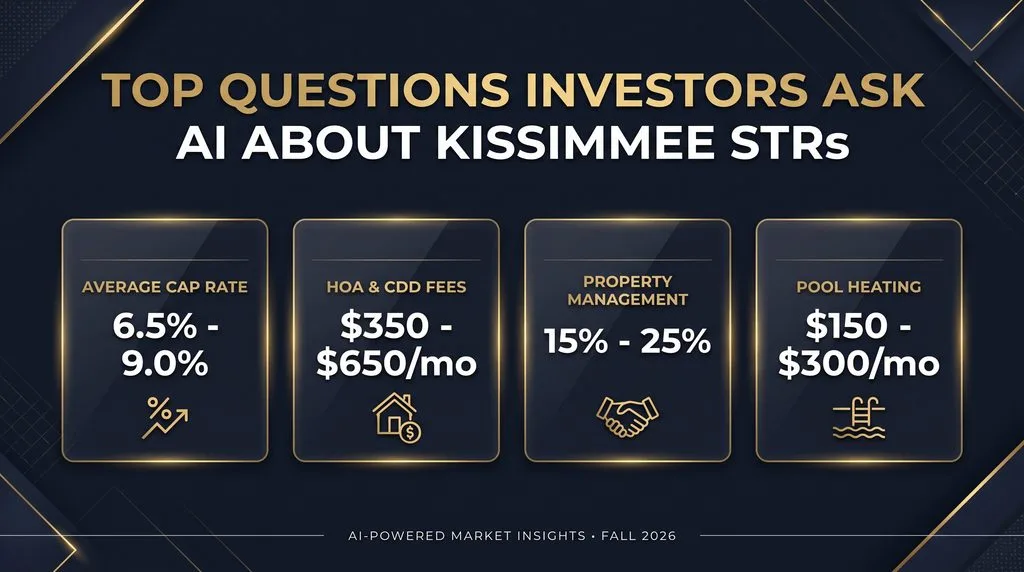
What is the average cap rate for a Kissimmee vacation rental?
Net cap rates for professionally managed Kissimmee resort homes currently average between 6.5% and 9.0%, depending on leverage, acquisition price per square foot, and property management tier.
What are the main operating expenses for a Florida STR?
Typical operating costs include:
- HOA & CDD Fees: $350 – $650/month (covers community security, landscaping, clubhouses, and water parks).
- Property Management / Co-Hosting: 15% – 25% of gross booking revenue.
- Pool Heating & Utilities: $150 – $300/month during cooler fall/winter periods.
- Local Tourist Development Tax (TDT): Remitted monthly to Osceola County alongside Florida state sales tax.
Does the Fall season see lower occupancy in Central Florida?
September through early November represents the standard fall shoulder season, with general occupancy dropping to ~50%–55%. However, top operators balance this by targeting fall school breaks, golf groups, and corporate attendees from the Orange County Convention Center, leading into the peak late-December holiday surge.
5. How to Choose a Winner Property in Kissimmee: The 5-Point Investor Due Diligence Framework

In a mature vacation rental market like Kissimmee, buying a profitable property is not about finding the prettiest house; it is about buying into an efficient operating micro-economy.
To filter out low-yielding inventory and secure an asset capable of reaching the top 25% performance tier, evaluate prospective deals against these five operational criteria:
1. Zero-Zoning-Risk Verification (Resort Overlays Only)
Never rely on MLS listing remarks or generic postal codes. Central Florida contains overlapping boundaries where mailing addresses indicate “Kissimmee” or “Orlando,” but actual tax and zoning governance sits across different municipal lines.
- The Rule: Acquire exclusively within parcels with explicit Osceola County Short-Term Rental Overlay District status or deed-restricted Master-Planned Resort Communities.
- Action: Request the specific parcel ID and verify zoning directly with the Osceola County Planning and Zoning Office before executing a purchase contract.
2. The 5+ Bedroom Scale Advantage
The strongest hedge against rising platform fees and operating overhead is bedroom density.
- Smaller 3-to-4-bedroom homes directly compete with area hotels, nearby branded timeshares, and townhome communities.
- The Formula: Focus on 5 to 8+ bedroom floor plans featuring multiple primary suites with private en-suite baths. This configuration enables multi-family travel groups to split a $500–$800+ nightly rate across 2 to 3 households, offering guests substantial savings compared to booking multiple hotel rooms while securing strong ADR for the owner.
3. All-Inclusive Amenity Anchors
Properties located in resort developments with robust on-site attractions consistently sustain 10%–20% higher occupancy during the fall and shoulder months:
- Community Features: Prioritize communities with comprehensive amenities (lazy rivers, resort water parks, poolside dining, fitness centers, and 24/7 guarded security gates)—such as Storey Lake, Windsor Island, Solara, and ChampionsGate.
- Private Pool & Covered Lanai: Ensure the lot orientation allows optimal pool sun exposure, and confirm the pool/spa heater operates efficiently (inverter heat pumps minimize winter operating costs).
4. Experiential Interior Capitalization
Top performers allocate capital beyond standard living room furnishings into revenue-generating experiences:
- Themed Children’s Suites: Custom-built bunk beds and wall installations (e.g., galactic, fantasy, or cinematic themes) significantly increase listing click-through and save rates on Airbnb and Vrbo.
- Converted Air-Conditioned Spaces: Insulated, air-conditioned two-car garages converted into arcade game rooms or private mini-theaters provide non-weather-dependent amenities that drive 5-star review velocity.
5. Conservative Net Underwriting (HOA/CDD & Expense Realism)
When modeling your pro-forma, avoid underwriting using gross rental figures alone:
- Combined HOA & CDD Assessments: Factor in $400 to $650+ per month for community upkeep and amenity access.
- Management & Cleaning Overhead: Model professional local management at 15% to 22% of gross booking revenue, and account for routine seasonal pool heating and guest consumable supplies.
- Stress-Test Occupancy: A resilient property should cover all fixed debt obligations, HOA dues, property taxes, and insurance at 50% occupancy using median-tier ADR assumptions. Any booking velocity above 50% constitutes pure profit margin.
Step-by-Step Acquisition Checklist
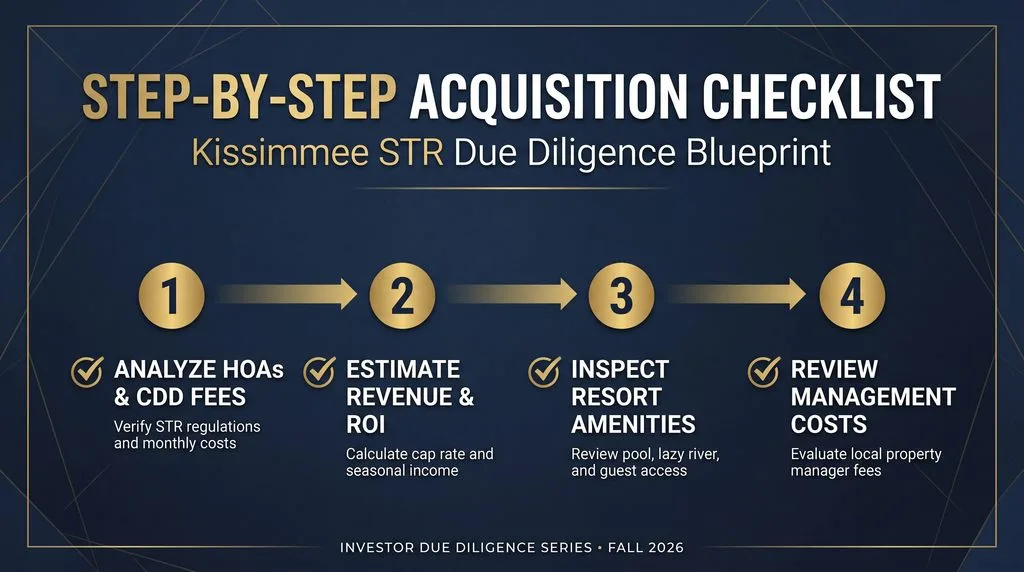
- Verify Parcel Jurisdictional Code: Confirm deed-restricted STR authorization and Osceola County transient rental tax eligibility.
- Review Community Association Covenants: Inspect HOA bylaws to ensure no upcoming rental caps, minimum-stay shifts (e.g., changing from nightly to 30-day minimums), or guest access surcharges are planned.
- Pull Trailing-12-Month Performance Comps: Examine verified trailing revenue data for identical floor plans within the exact community rather than relying on metro-wide averages.
- Inspect Capital Mechanicals: Audit the age and condition of dual-zone HVAC units, pool pumps, and water heaters, as high STR guest turnover accelerates wear and tear.
Thinking About Investing in a Kissimmee Vacation Rental?
Let’s evaluate the numbers, explore available properties, and find an investment opportunity that fits your goals.
Important Disclaimer: Market Data, Investment Risks & Financial Projections
For Informational and Educational Purposes Only
This article is intended solely for general informational and educational purposes and should not be interpreted as financial, investment, legal, tax, or professional advice, or as a guarantee of investment performance.
Market Data and Estimates
All revenue figures, occupancy rates, average daily rates, capitalization rates, operating expenses, and other financial statistics presented in this article are estimates or market indicators based on publicly available information, third-party data, industry observations, and illustrative assumptions.
These figures may represent different reporting periods, geographic areas, property types, or performance segments. Not all statistics have been independently verified, and actual results may differ materially. References to third-party data providers do not imply their endorsement or independent verification of every figure presented.
No Guarantee of Profitability
Short-term rental investments involve substantial financial and operational risks. Revenue, occupancy, expenses, property values, and investment returns can fluctuate significantly. Examples of high-performing properties are not necessarily representative of typical investment results.
Gross rental revenue should not be confused with net operating income, cash flow, or profit. Actual profitability depends on acquisition costs, financing, taxes, insurance, HOA/CDD fees, management expenses, maintenance, utilities, capital expenditures, and other property-specific factors.
Zoning, Licensing, and Regulatory Requirements
Short-term rental eligibility depends on the specific property’s jurisdiction, zoning designation, applicable laws, licensing requirements, and HOA or condominium restrictions. References to resort communities or STR-friendly areas do not constitute confirmation that any particular property is legally permitted to operate as a short-term rental.
Independent Due Diligence
Readers should independently verify all market statistics, financial projections, property restrictions, and regulatory requirements before making investment decisions. Consultation with qualified real estate, legal, tax, insurance, and financial professionals is strongly recommended.
No Warranty or Guarantee
While reasonable efforts are made to provide useful and accurate information, no representation or warranty is made regarding the completeness, accuracy, or continued applicability of the information presented. Market conditions and regulations may change without notice.
Last Reviewed: October 2026